
The Dark Side Of Positive Thinking
Here’s something that surprised me when doing research for my upcoming book Beyond Belief:
Positive visualization often doesn’t work. In fact, it can make things worse.
I know that’s hard to hear, especially when Instagram is filled with manifestation coaches and vision boards. But the research is crystal clear.
📚The Problem With Imagining Success
Dr. Gabriele Oettingen at NYU spent decades studying goal-setting. Her findings: The more positively people fantasize about success, the less well they actually do.
In one study, she hooked people up to blood pressure monitors and asked them to visualize achieving their biggest dreams: landing the job, losing weight, finding romance.
Their blood pressure dropped immediately.
Why? The fantasy gave them a temporary high...but it drained the energy needed for actual effort. Their brains acted as if they’d already succeeded.
From academic tests to weight loss to career advancement, positive fantasies consistently led to worse outcomes.
🧲Here’s Why Positive Thinking Backfires
When you vividly imagine achieving a goal, your brain registers some of the emotional reward before any work has been done. You feel encouraged, even satisfied, as if progress is already underway.
But the reality of pursuing that goal is almost always harder than the fantasy suggests. When friction appears, effort declines, persistence weakens, and the gap between imagination and reality feels discouraging.
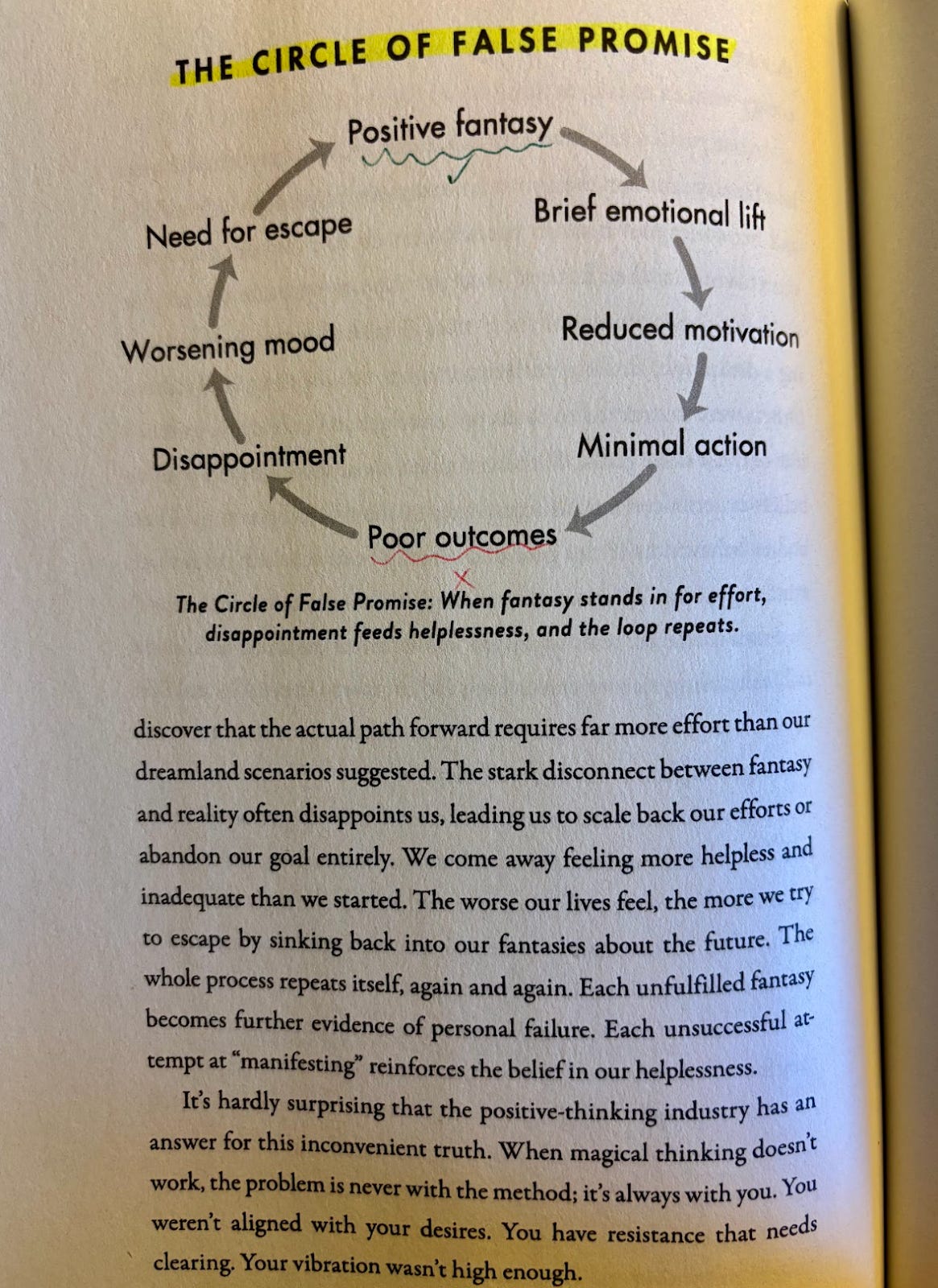
To escape those feelings, it’s easy to return to the fantasy rather than engage the work itself. Over time, this creates a loop in which imagining success subtly replaces pursuing it.
In Beyond Belief, I call this “The Circle of False Promise.”
🧩The Solution: Mental Contrasting
Dr. Oettingen discovered the solution: mental contrasting.
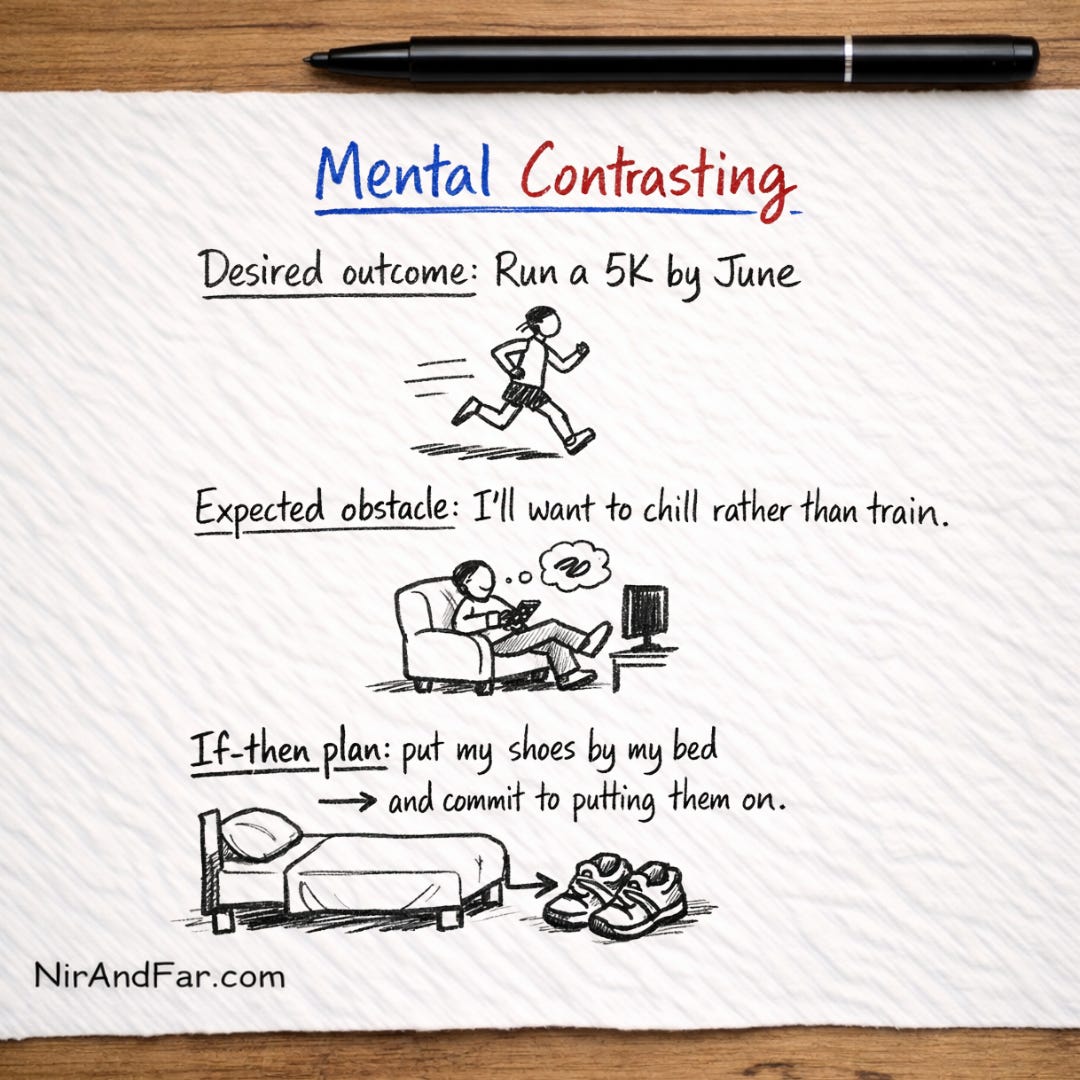
Instead of visualizing success in isolation, you deliberately pair your desired outcome with the real obstacles in your way. Then you construct an “if-then” strategy that specifies what you’ll do when that obstacle appears.
For example:
Desired outcome: Run a 5K by June
Visualization: Crossing the finish line, feeling strong
Obstacle: Wanting to chill/rest instead of train for the run
If-then plan: If I’m tempted to sleep in, then I’ll put my shoes by my bed and commit to just putting them on.
Studies show people who practice mental contrasting stick with goals longer, achieve more, and feel less discouraged when challenges appear.
Why? Because mental contrasting engages what I describe in Beyond Belief as the three powers of belief:
Attention: You see obstacles clearly instead of filtering them out.
Anticipation: You expect and prepare for difficulty, not just success.
Agency: You build conviction that you can handle challenges.
So the next time you want to set a goal, rather than visualizing or manifesting it, try mental contrasting instead.
Believe,
Nir
GET BEYOND BELIEF TODAY & UNLOCK EXCLUSIVE BONUSES
1️⃣ Live “Break Through Limiting Beliefs” Workshop with me
Date: March 21, 2026 @ 12pm ET / 4pm GMT
I’ll walk you through the exact belief-change exercises I’ve used with leadership teams at JPMorgan Chase, Amazon, PwC, and the U.S. Air Force.
Can’t attend live? I’ll send you the full replay + materials we used.
2️⃣ The 30-Day Belief Transformation Journal (instant access)
This journal gives you a simple daily system for catching limiting beliefs, reframing them, and gathering real-world evidence for better ones.
3️⃣ NEW: Beyond Belief at Work Private Interview Series
Exclusive access to conversations with Kim Scott, Dr. David Burkus, Jon Levy. These aren’t public podcast episodes. They’re candid, practical conversations on the belief systems that determine how teams think, decide, and perform.
If this sounds interesting to you,
1️⃣Preorder BEYOND BELIEF today
2️⃣Claim your exclusive bonuses